

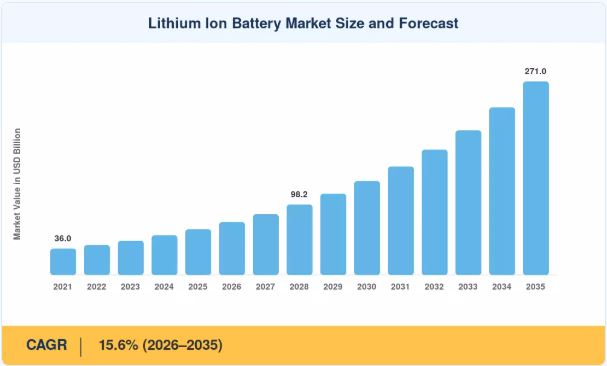
Lithium-Ion Battery Market Poised for 15.6% CAGR, Growing from USD 73.5 Billion in 2026 to USD 271.0 Billion by 2035
Lithium-Ion Battery Market
Lithium-Ion Battery Market Size, Share and Research Report By Type (Lithium Nickel Manganese Cobalt, Lithium Manganese Oxide, Lithium Iron Phosphate
Lithium-Ion Battery Market: Driven by rising electric vehicle adoption, renewable energy storage, and demand for high-performance portable power solutions.”
NEW YORK,, NY, UNITED STATES, August 13, 2026 /EINPresswire.com/ -- The Global Lithium-Ion Battery market reached an estimated USD 63.5 billion in 2025 and is projected to grow from USD 73.5 billion in 2026 to USD 271.0 billion by 2035, registering a CAGR of 15.6% during the forecast period 2026–2035. Government mandates accelerating vehicle electrification including the EU's 2035 combustion engine phase-out and the U.S. Inflation Reduction Act's USD 7,500 EV tax credit have turned battery procurement into a strategic priority for automakers and grid operators alike. — Market Research Future (MRFR)
The market sits at the intersection of transportation decarbonization, grid modernization, and portable electronics innovation, making it one of the most capital-intensive segments of the global energy transition. The market's 15.6% CAGR reflects the convergence of government EV mandates and purchase incentives (+3.5% impact), gigafactory capacity expansion (+3.0%), grid-scale energy storage mandates (+2.5%), and cell chemistry cost reduction (+2.2%) accelerating across the world's largest automotive and clean-energy economies simultaneously.
A technology transformation is reshaping the industry. Legacy cylindrical NMC cells that dominated a decade ago are now competing with prismatic LFP architectures that eliminate cobalt dependency and cut pack-level costs below USD 100/kWh in leading Chinese facilities. Concurrently, global investment in gigafactory capacity surpassed USD 150 billion between 2022 and 2025, with CATL, LG Energy Solution, and Panasonic each committing to multi-continent manufacturing footprints.
Asia-Pacific commands the dominant position in the market with approximately 48% revenue share in 2025, driven by China's integrated cell-to-pack supply chain. North America represents the fastest-growing corridor at an estimated 17.4% CAGR, fueled by IRA-linked domestic content incentives.
Get Full PDF Sample Copy of Report: (Including Full TOC, List of Tables & Figures, Chart) @
https://www.marketresearchfuture.com/sample_request/979
➤ How Significant Is the Lithium-Ion Battery Market's Growth?
The lithium-ion battery market's trajectory from USD 63.5 billion in 2025 to a projected USD 271.0 billion by 2035 represents more than a four-fold expansion over the forecast decade, reflecting the structural shift from cylindrical NMC cells toward cost-optimized prismatic LFP architectures and next-generation chemistries deployed across automotive, grid storage, and consumer electronics. The market's 15.6% CAGR is anchored in an electrification-and-manufacturing supercycle where government EV mandates, gigafactory capacity buildout, and grid-scale storage regulation are all converging to make lithium-ion batteries the foundational technology of the global energy transition.
NMC chemistry held the largest technology share at approximately 38% in 2025, sustained by high energy density requirements in premium EV platforms, while LFP cells represent the fastest-growing chemistry segment at an estimated 18.3% CAGR through 2035, driven by cost advantages and improved cold-weather performance. LCO chemistry contributed roughly USD 8.9 billion in 2025, anchored by smartphone and laptop demand. By application, the automotive and EV segment accounted for approximately 52% of the market in 2025, reflecting accelerating fleet electrification, while energy storage systems registered the highest application CAGR at an estimated 19.1%, propelled by grid-scale deployment mandates.
➤ What Does the Future Hold for the Lithium-Ion Battery Market?
Government EV mandates and purchase incentives contribute approximately +3.5 percentage points to the lithium-ion battery market's CAGR the single highest driver impact. All-electric drivetrains are essentially required under the EU's Fit for 55 package, which calls for a 100% reduction in CO2 emissions from new passenger cars by 2035. Since August 2022, the IRA's Section 30D clean vehicle credit, worth up to USD 7,500 per vehicle, has diverted approximately USD 120 billion in announced investments in battery and electric-vehicles manufacturing to the United States, while China's extension of NEV purchase subsidies through provincial programs continues to support the world's largest EV market, which produced 9.5 million battery-electric vehicles in 2024 alone.
Gigafactory capacity expansion contributes approximately +3.0 percentage points to the CAGR, establishing manufacturing scale as a primary structural demand source. Announced worldwide gigafactory capacity surpassed 7,000 GWh between 2023 and 2025, more than tripling the installed base of 2022. Rapid regional diversification of cell manufacturing is demonstrated by LG Energy Solution's joint ventures in Michigan and Indonesia, Panasonic's Kansas facility, and CATL's 100 GWh Debrecen plant in Hungary, with this capacity buildout directly reducing per-unit cell costs by distributing capital expenditure over higher volumes.
Grid-scale energy storage mandates add a further +2.5% to the CAGR as California's AB 2514 and FERC Order 2222 have opened wholesale electricity markets to battery storage aggregations, catalyzing over 16 GW of grid-connected storage installations in the United States by 2024, while Australia's National Electricity Market roadmap targets 46 GW of dispatchable storage by 2050.
The next phase of the market's evolution centers on an electrification supercycle and fleet turnover, as the IEA projects EVs will represent over 60% of new car sales by 2030 and nearly 80% by 2035, directly scaling the market as average pack sizes increase from 60 kWh today to 75–80 kWh amid rising range expectations, while heavy-duty trucking electrification led by Tesla Semi, Daimler eActros, and Volvo FH Electric adds a parallel demand vector requiring 400–600 kWh packs per vehicle.
AI is transforming battery production from electrode coating through formation cycling, with AI-based defect detection systems reducing scrap rates by 30–40% and digital twin models optimizing gigafactory throughput without physical prototyping. supply chains, while solid-state batteries promising 400-plus Wh/kg energy densities remain targeted for commercial automotive deployment around 2028–2030.
Get access to the full description of the report @
https://www.marketresearchfuture.com/reports/lithium-ion-battery-market-979
➤ Who Are the Key Players in the Lithium-Ion Battery Market?
The lithium-ion battery market exhibits moderate-to-high concentration, with the top five manufacturers CATL, LG Energy Solution, BYD, Panasonic, and Samsung SDI holding an estimated 72–76% combined global share by installed GWh capacity in 2025. The Herfindahl-Hirschman Index sits at an estimated 1,400–1,600, placing the industry in the moderately concentrated range. Regional entrants such as Northvolt, AESC, and CALB are eroding top-tier dominance, but scale economics and upstream integration create significant barriers to entry. MRFR identifies the following key participants with estimated revenue share ranges:
★ CATL (~32–36% share) - the global volume leader with diversified chemistry, providing NMC, LFP, and sodium-ion cells alongside CTP technology, having launched the second-generation Blade Battery with a 15% energy density improvement in partnership with BYD's broader platform strategy.
★ LG Energy Solution (~13–16% share) - a JV-driven North America expansion specialist providing pouch NMC cells and cylindrical cells for Tesla and GM, anchoring its growth through joint-venture manufacturing partnerships across Michigan and Indonesia.
★ BYD (~12–15% share) - a cost leader with own-brand EV synergy providing the Blade Battery (LFP) and full vertical integration, having launched its second-generation Blade Battery in July 2024 with integrated cell-to-body architecture reducing pack weight by 10%.
★ Panasonic Energy (~8–11% share) - a premium cell technology provider based in Japan and the U.S. offering cylindrical NCA/NMC cells and its 4680 partnership with Tesla, anchoring long-term automotive supply agreements from its Kansas gigafactory.
★ Samsung SDI (~6–9% share) - a premium automotive-focused player expanding in the EU, providing prismatic NMC cells and a solid-state R&D pipeline positioned for next-generation chemistry leadership.
★ SK On (~4–6% share) - an aggressive North America capacity builder providing NCM pouch cells through joint ventures with Ford and Hyundai, targeting rapid scale-up across new U.S. manufacturing sites.
★ CALB (~3–5% share) - a fast-growing Chinese mid-tier provider offering large-format LFP and NMC cells for energy storage system applications, expanding rapidly across both domestic and export markets.
★ Northvolt (~1–3% share) - a sustainability-first positioning specialist offering European-sourced NMC cells with a recycled-content focus, targeting environmentally differentiated procurement within the EU Battery Regulation framework.
★ EVE Energy (~2–4% share) - a diversified end-market exposure provider offering cylindrical and prismatic LFP and NMC cells, serving a broad mix of automotive, energy storage, and consumer electronics customers.
★ AESC / Envision (~2–3% share) - an OEM-captive manufacturing model specialist providing pouch NMC cells for Nissan and Renault, anchoring long-term supply relationships with legacy EV manufacturers.
➤ What Are the Emerging Trends in the Lithium-Ion Battery Market?
Several transformational trends are redefining the lithium-ion battery market's evolution through 2035:
Government EV Mandates and Purchase Incentives: The EU's Fit for 55 package mandates a 100% reduction in new passenger car CO2 emissions by 2035, while the IRA's Section 30D clean vehicle credit has diverted approximately USD 120 billion in announced battery and EV manufacturing investment to the United States since August 2022.
Gigafactory Capacity Expansion: Announced worldwide gigafactory capacity surpassed 7,000 GWh between 2023 and 2025, more than tripling the installed base of 2022, with LG Energy Solution, Panasonic, and CATL each diversifying manufacturing footprints across Michigan, Indonesia, Kansas, and Hungary.
Grid-Scale Energy Storage Mandates: FERC Order 2222 has opened U.S. wholesale electricity markets to battery storage aggregations, catalyzing over 16 GW of grid-connected storage installations by 2024, while Australia's National Electricity Market roadmap targets 46 GW of dispatchable storage by 2050.
Cell Chemistry Cost Reduction: Pack-level costs for LFP batteries fell below USD 100/kWh in Chinese Tier-1 facilities during 2024 a milestone long considered the threshold for unsubsidized EV price parity with internal combustion vehicles while silicon-anode blending pushes NMC energy densities above 300 Wh/kg.
Battery Recycling and Circular Economy Regulations: The EU Battery Regulation's digital passport mandate, effective 2027, creates a transparent chain-of-custody framework unlocking secondary market liquidity for retired EV battery packs retaining 70–80% of original capacity, representing a multi-billion-dollar stationary storage repurposing opportunity.
Buy Full Research Report:
https://www.marketresearchfuture.com/checkout?currency=one_user-USD&report_id=979
➤ How Is the Lithium-Ion Battery Market Segmented?
The lithium-ion battery market report provides a comprehensive segmentation framework:
By Type: Lithium Nickel Manganese Cobalt / NMC (38% share, 2025), Lithium Iron Phosphate / LFP (18.3% CAGR), Lithium Cobalt Oxide / LCO (USD 8.9 billion, 2025), Lithium Manganese Oxide / LMO (8% share, 2025), Lithium Nickel Cobalt Aluminum Oxide / NCA, Lithium Titanate Oxide / LTO, Others — Solid-State emerging (21.5% CAGR)
By Capacity: 0–3,000 mAh, 3,000–10,000 mAh, 10,000–60,000 mAh, 60,000 mAh & Above
By Voltage: Low — below 12V, Medium — 12V to 36V, High — above 36V
By Industry / Application: Automotive / EV (52% share, 2025), Consumer Electronics (USD 14.0 billion, 2025), Energy Storage Systems (19.1% CAGR), Industrial — Forklifts, UPS, Telecom (10% share, 2025), Aerospace, Marine, Medical
By End User: Automotive OEMs (48% share, 2025), Electronics Manufacturers (13.8% CAGR), Utilities & Grid Operators (USD 9.5 billion, 2025), Industrial & Telecom (10% share, 2025), Others — Military, Medical, Aerospace (17.6% CAGR)
By Region: Asia-Pacific (USD 30.5 billion, 2025), North America (17.4% CAGR), Europe (21% share, 2025), South America (USD 3.2 billion, 2025), Middle East & Africa (14.8% CAGR)
➤ What Are the Regional Insights from the Lithium-Ion Battery Market?
Asia-Pacific leads the lithium-ion battery market with USD 30.5 billion in 2025 revenue, built on a vertically integrated supply chain stretching from Ganfeng Lithium's spodumene processing to CATL's cell-to-pack assembly lines. China commands roughly 62% of regional share through CATL and BYD's vertical integration. Japan contributed USD 3.8 billion through continued R&D spending toward solid-state prototypes, positioning itself for premium chemistry leadership beyond 2028.
South Korea is posting a 16.2% CAGR within the region through LG and Samsung SDI's global expansion, India contributed USD 1.5 billion through its Production Linked Incentive scheme, which has allocated INR 181 billion (approximately USD 2.2 billion) to attract domestic cell manufacturing with Reliance New Energy, Ola Electric, and Tata Group among committed investors, and the rest of Asia-Pacific is growing at a 15.8% CAGR through ASEAN EV adoption acceleration.
North America represents the fastest-growing region in the lithium-ion battery market at an estimated 17.4% CAGR through 2035, with the United States commanding roughly 78% of regional share as over USD 80 billion in battery-related manufacturing investment has been announced since the IRA's passage.
Major plants from Panasonic in Kansas, LG Energy Solution in Michigan, and SK On in Georgia are targeting combined capacity exceeding 300 GWh by 2028. Canada is growing at a 16.8% CAGR through critical minerals mining and refining, leveraging abundant hydroelectric power and nickel deposits across its Ontario and Quebec corridors to position as cathode active material refining hubs, and Mexico contributed USD 0.9 billion through nearshoring of pack assembly.
Europe holds approximately 21% of global lithium-ion battery market share, anchored by its automotive OEM base. Germany commands roughly 28% of regional share as Volkswagen, BMW, and Mercedes-Benz collectively represent over 4 million annual EV-capable platforms by 2028. France is posting a 15.9% CAGR through the ACC gigafactory consortium, the United Kingdom contributed USD 1.4 billion through Britishvolt successor projects, the Nordic countries are growing at a 17.1% CAGR through Northvolt's expansion and access to green energy, and the rest of Europe holds roughly 18% of regional share through growing southern European cell assembly, with the EU Battery Regulation's mandatory carbon footprint declarations and recycled content thresholds — 12% cobalt and 4% lithium by 2030 — creating compliance-driven demand for traceable European cell production.
South America's role in the lithium-ion battery market is shaped by its position in the Lithium Triangle, where Chile, Argentina, and Bolivia hold over 55% of global lithium reserves. Brazil commands roughly 52% of regional share through ANEEL storage frameworks and its growing EV market alongside solar-plus-storage deployments creating downstream pull, Chile is posting a 14.5% CAGR through upstream lithium brine production under its National Lithium Company framework aiming to capture more value-added processing domestically, and Argentina contributed USD 0.5 billion through Lithium Triangle mining expansion.
➤➤➤ Regional & Country-Level Reports by Market Research Future:
US Lithium Ion Battery Market -
https://www.marketresearchfuture.com/reports/us-lithium-ion-battery-market-13082
Germany Lithium Ion Battery Market -
https://www.marketresearchfuture.com/reports/germany-lithium-ion-battery-market-13960
Europe Lithium Ion Battery Market -
https://www.marketresearchfuture.com/reports/europe-lithium-ion-battery-market-46990
South America Lithium Ion Battery Market -
https://www.marketresearchfuture.com/reports/south-america-lithium-ion-battery-market-46989
GCC Lithium Ion Battery Market -
https://www.marketresearchfuture.com/reports/gcc-lithium-ion-battery-market-46987
UK Lithium Ion Battery Market -
https://www.marketresearchfuture.com/reports/uk-lithium-ion-battery-market-46983
South Korea Lithium Ion Battery Market -
https://www.marketresearchfuture.com/reports/south-korea-lithium-ion-battery-market-46984
Japan Lithium Ion Battery Market -
https://www.marketresearchfuture.com/reports/japan-lithium-ion-battery-market-46985
France Lithium Ion Battery Market -
https://www.marketresearchfuture.com/reports/france-lithium-ion-battery-market-46986
Italy Lithium Ion Battery Market -
https://www.marketresearchfuture.com/reports/italy-lithium-ion-battery-market-46988
Sagar Kadam
Market Research Future
+ +1 628-258-0071
email us here
Legal Disclaimer:
EIN Presswire provides this news content "as is" without warranty of any kind. We do not accept any responsibility or liability for the accuracy, content, images, videos, licenses, completeness, legality, or reliability of the information contained in this article. If you have any complaints or copyright issues related to this article, kindly contact the author above.
